For the capital partner · name + money · Jul 2026
Lease the kitchens.
Own the bar.
That is how sophisticated F&B wins.
CRAVE is not “we hope restaurant works.” It is a landlord + beverage structure used by the smartest food halls and hotel F&B owners on earth: put six hungry chefs in licensed kitchens (we collect rent + a slice of sales), and keep the highest-margin asset — the bar — under Mirage control. Your capital underwrites residences first; this stack is how we turn Door 2 into a destination without betting the building on one chef’s ego.
0 · The restaurant’s outdoor room — grand court (not lobby)
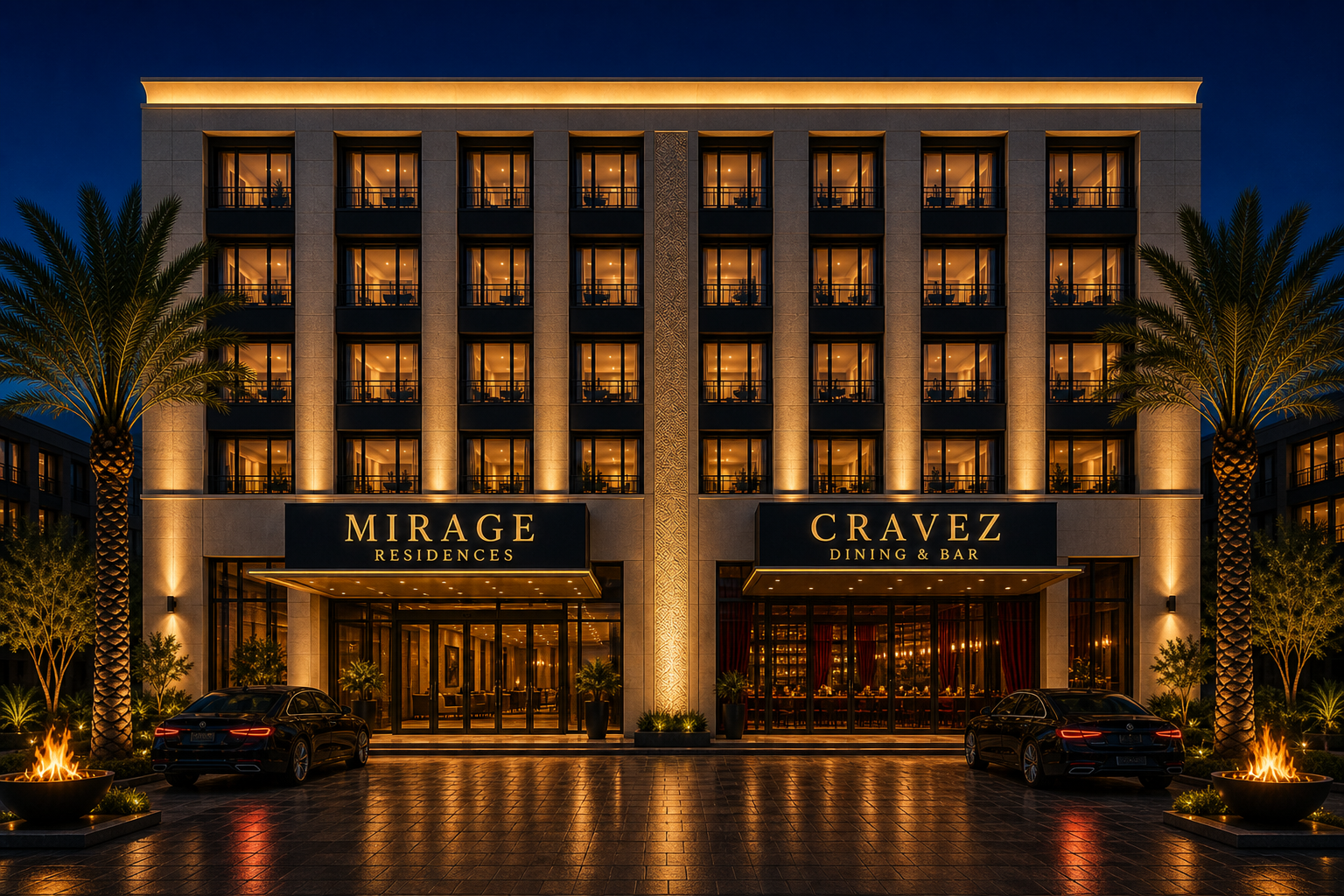
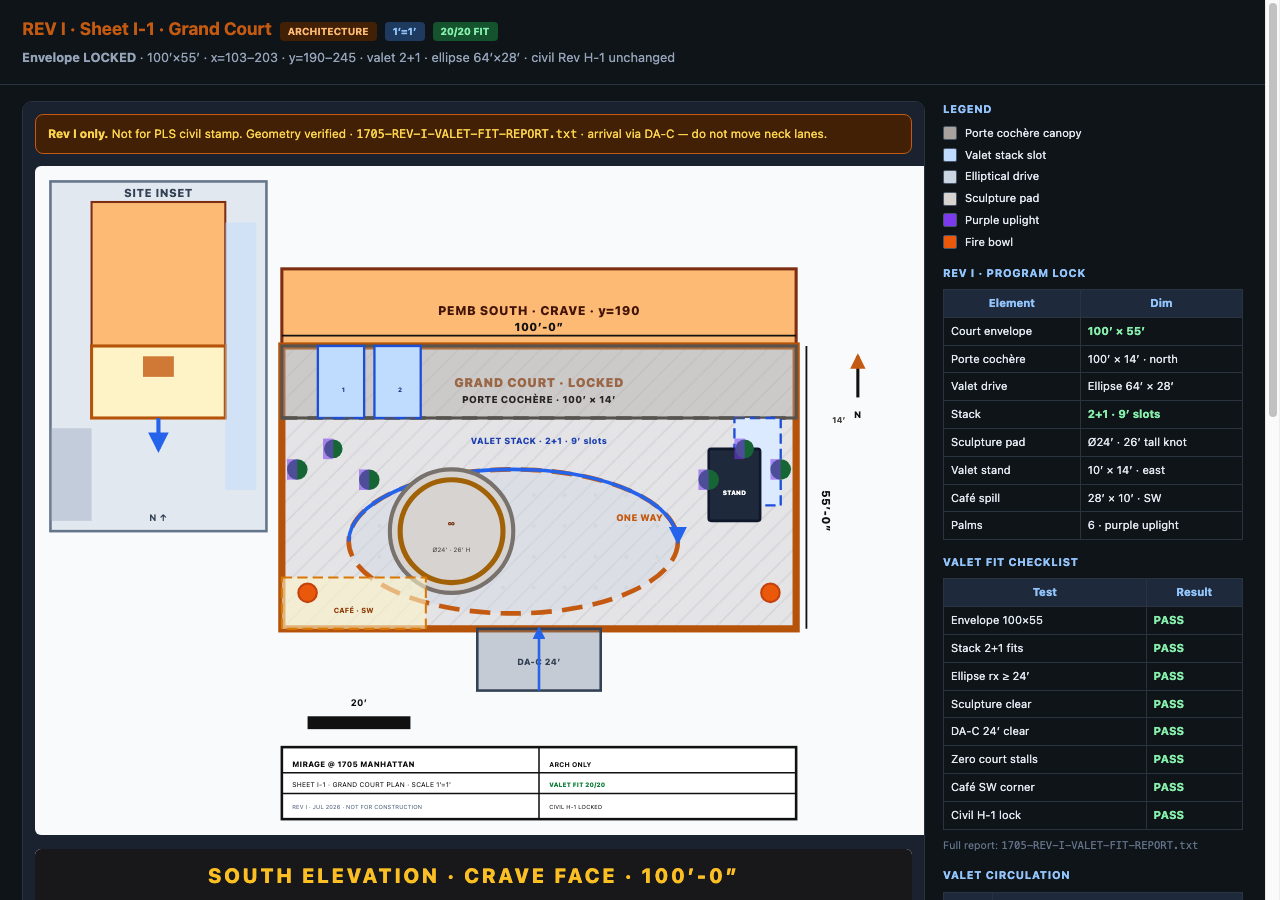
Door 2 does not end at the host stand. CRAVE opens onto the same 100′ × 55′ = 5,500 SF outdoor grand court that sells the night: stone pavers · palms · fire bowls lit · café spill · Saints / watch wall · bar glasses walking outside. That is CRAVE’s patio — the dual-entry living room — not a pocket yard behind the kitchen, and not the private north pool court (key-card · hotel side · 12′×20′ pool).

1 · Why the commissary / multi-kitchen program works
CRAVE Door 2 = shared hall + six independent chef kitchens + one Mirage bar + grand-court spill (5,500 SF). Chefs bring their own brands, menus, and crews. Mirage brings the room, grease path, host stand energy, the outdoor living room, parking, hotel guests upstairs, and ~45,000 cars/day on Manhattan Blvd.
What Mirage is (landlord)
Build the A-2 kitchen shell · grease / hoods / BOH · dining room & court · brand & traffic. Collect 6 × $1,500 base plus 15% of whatever they bring in — every ticket on the mandatory house POS (no side Square / toast tablets). Refresh a weak concept without shuttering the whole restaurant.
What chefs are (operators)
Cook what they are famous for. Hire their line. Own their Instagram / clientele. Pay a predictable license instead of $400k+ buildout and a five-year strip lease. They win on food margin; we win on rent + beverage.
Six reasons this structure is stronger than one Mirage restaurant
- Risk is diversified. One bad menu does not kill Door 2. Swap a kitchen; keep the hall open. A single Mirage restaurant is binary — full house or empty dining room.
- Labor does not land on the investor. Culinary payroll, worker’s comp, tip theft, no-shows — that sits with six operators. Mirage is not staffing six cook lines.
- Variety sells the boulevard. Gulf · Creole · Latin · Asian · late-night · healthy — six concepts pull six audiences. One Mirage menu cannot out-Curate that without a $2M culinary team.
- Cash is contractual first. Base licenses are rent-like dollars banks recognize — more durable than an unproven brunch forecast.
- Upside is whatever they ring. 15% of gross kitchen sales through the house POS — if a chef does $40k, Mirage takes $6k from that kit on top of base. No inventory risk for Mirage.
- POS is non-negotiable. License says: house system only. That makes the 15% auditable for you, the bank, and the partner — not a percent of “trust me.”
- Hotel guests already live upstairs. monthly hotel residences need dinner options for weeks — not one hotel restaurant they get tired of by night four.
2 · Why this beats Mirage cooking ourselves
| Dimension | Mirage cooks (single restaurant) | CRAVE kitchens (our model) |
|---|---|---|
| Investor downside | You fund food inventory, chef ego, and empty seats when the menu misses | You fund real estate. Chefs fund food. Empty kitchen = replaceable license |
| Labor | Full BOH + FOH payroll on the property P&L — softest line in hospitality | Operator payroll. Mirage keeps host / bar / facility only |
| Food cost volatility | Mirage eats shrimp spikes and spoilage | Chef eats COGS; we take % of their sales after they fight the market |
| Brand risk | One concept failure stains the whole hotel story | CRAVE brand stays; individual kitchens rotate like Time Out vendors |
| What banks underwrite | Seldom — restaurant ops are a small-business loan inside a hotel | Base licenses look like tenant rent once LOIs / leases are signed |
| Margin quality | Food typically ~30–45% gross after COGS — thin, labor-heavy | Landlord collect rent + % ; keep bar at ~65–80% gross margin |
| Who builds culinary IP | We would have to invent six menus and six followings from zero | Chefs bring existing followings to Manhattan Blvd on day one |
3 · Brands & platforms that already proved this works
We are not inventing an exotic idea. We are importing the winning pieces of models that already cleared cities, landlords, and investors — sized to Harvey and a 100′×110′ PEMB.
| Proven name | What they proved | What Mirage copies |
|---|---|---|
| Time Out Market Lisbon → NYC · Miami · Chicago · Dubai · more |
Curated chef kitchens under one roof + destination energy. Markets run multiple bars as the glue. Vendors refresh; the Market brand stays. | CRAVE curation — six chef spots, one hall identity, Mirage-owned bar as the financial engine of Door 2 |
| Tiny Drumsticks NYC shared / commissary kitchens |
Started from Smorgasburg vendor need; scaled to NYC’s largest shared-kitchen footprint (~$4M annual rent model reported) without becoming a ghost-kitchen fad casualty. | Landlord math — chef businesses rent production / kitchen capacity; Mirage owns the facility, not the food IP |
| Nimbus Kitchens NYC · profitable shared kitchens + FOH |
Profitable since founding by pairing kitchen rent with community / pop-up front-of-house — not pure delivery ghost boxes. | Hall + kitchens, not ghost boxes — customers sit, eat, post, spill to the court |
| Food-hall bar playbook Industry standard (Tabski / operator literature) |
Food vendors run ~30–45% gross after food cost; a well-run bar runs ~65–80%. Leasing the bar away is called the most expensive mistake in the category. | Keep the bar — never hand the profit center to a tenant |
| Hotel F&B outsourcing HVS + asset-manager practice |
Smart owners outsource thin-margin restaurant cooking to branded operators (base + %), while protecting what drives the property identity and margin. | Lease food · control beverage & arrival — residences stay the bank core; CRAVE amplifies ADR / stay length / local pull |
| Smorgasburg / open-air markets Vendor ecosystems nationwide |
Proved America will hunt multi-vendor food destinations — chefs can build cult followings without owning four walls alone. | Permanent Smorgasburg with air conditioning — six vendors, one Harvey address, hotel upstairs |
4 · Why keeping the bar is brilliant
It is where the money is
Industry food-hall math is blunt: food is traffic; beverage is profit. Vendors fight 30–45% food gross margins. Bars clear ~65–80% when run with discipline. If we leased the bar, we would build the richest square footage in the building — and gift it away.
It is the social magnet
People meet at the bar. Saints nights · court spill · beauty clients post-appointment · Residences guests after a long day. The bar turns six food concepts into one reason to stay for two more hours.
One license · one brand voice
Mirage controls ATC liquor path, pour standards, pricing, hours, and safety. We do not want six chefs arguing over who owns the tap wall — or a third-party bar tenant fighting CRAVE’s vibe.
Time Out does not give the bars away
Markets from Brooklyn to Dubai run multiple house bars as the connective tissue between chef stalls. We copy that instinct at Harvey scale: one Mirage bar, six kitchens around it.
Structural brilliance for your capital
| If we… | Investor outcome |
|---|---|
| Cooked all food ourselves and leased the bar | Worst of both worlds — food labor risk + gifted away high-margin beverage |
| Leased all F&B including bar to one restaurant group | Simple ops — but you leave 65–80% margin beverage and lose control of the nightlife energy that sells the residences |
| License kitchens + own the bar (CRAVE) | Best structure: contractual kitchen rent, diversified culinary draw, house keeps beverage profit + brand control |
5 · Closing pitch — why your name belongs on this
- Residences are the bankable core — 56 residence keys / all-in rents / Highland-grade occupancy story. That is what lenders understand.
- CRAVE kitchens are proven real estate — Time Out, Tiny Drumsticks, Nimbus, food-hall bar literature. Diversified chef risk beats Mirage cooking.
- Owning the bar is non-negotiable brilliance — keep the 65–80% gross-margin engine; never lease it away — and sell it onto the 5,500 SF grand court (fire bowls · watch nights · café spill).
- Optional L2 beauty/barber — Solera/Sola math that already beats the keys it replaces (swap test).
- Harvey already cleared an $8.3M Best Western Plus — hospitality capital closes in this parish; Mirage is the better concept (vs BW Plus).
- ~$3.5M all-in into a dual-entry campus on ~45k VPD — you are not buying a tired Lapalco box; you are funding the destination that strip never got.
Back to investor deck Bankable three-engine P&L residences vs BW Plus